The project starts with the operation
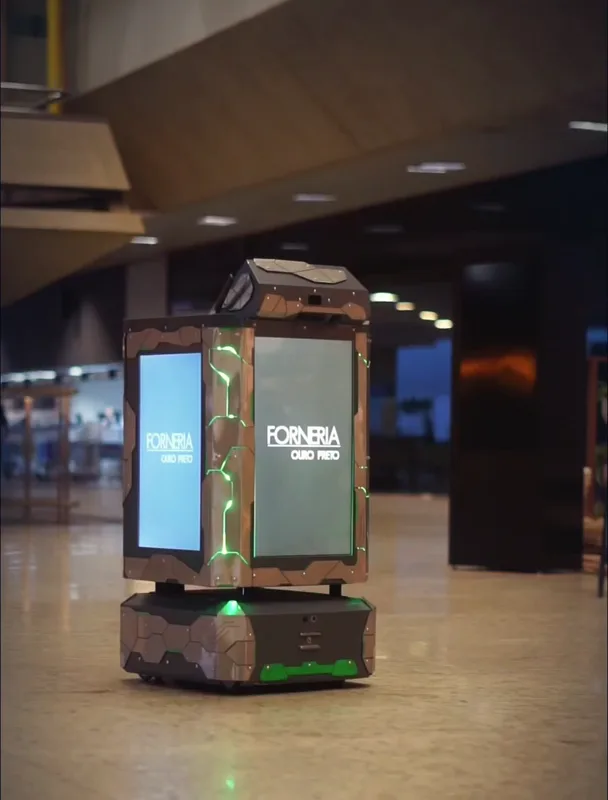
Anyone who sees SkyFood moving around the airport is looking at the result of work that started long before. At TracFtech, development begins with a practical question: how do you get an order from the store to the customer inside a shared space?
The challenge is more than moving a machine. We have to consider the pickup point, the compartment that carries the order, the available routes and how the customer collects the purchase. Each step has to make sense for whoever prepares, monitors and receives the delivery.
That view guides the development of SkyFood, our autonomous delivery robot. Structure, navigation and the digital platform are part of the same solution.
From technical drawing to manufacturing
Before the robot takes shape, we study its dimensions and the layout of its components. Technical drawings and digital modeling help organize the structure, the compartments and the space needed to integrate the systems.
Next, the project moves to manufacturing. Cutting and bending sheet metal are part of this stage, as are assembling the structure and installing the components. This is when the design decisions have to work in a physical machine.
The work continues with integrating the parts. A component can work on its own and still need adjustments once it runs alongside the others. That is why building the robot and putting the solution into operation are connected steps.
From development to operation at BH Airport
SkyFood's arrival at Belo Horizonte International Airport, in Confins, is a concrete application of this work. BH Airport's official announcement describes the service in the terminal's public area and reports more than 40 mapped delivery points, with room to expand.
The customer chooses products in the app, pays and picks the delivery point. The robot collects the order at the store and takes it to the chosen spot. The order is released for pickup through the app.
For users, the goal is to make this sequence easy. For the team building the solution, it brings together engineering, software and operational planning decisions. With passengers and luggage moving around, it is important to assess each site's routes and procedures.
What to assess before deploying a delivery robot
An airport deployment helps show the technology in use, but every site has its own conditions. Before defining the service, it is worth organizing the questions that guide the project:
- Route: where does the order start and where does it need to go? Are there level changes, doors or floor changes?
- Routine: who puts the order in the compartment and who handles any incidents?
- Infrastructure: which connectivity, charging and integration conditions need to be assessed?
- Shared use: how does the route coexist with people and with the site's rules?
- Results: which indicators will the operation track, such as service time, delivery volume and availability?
Our delivery robot deployment guide covers these points in depth. Requirements have to be confirmed for each project; no single configuration automatically fits every space.
Brazilian engineering applied to real needs
SkyFood represents TracFtech's work developing technology solutions with Brazilian engineering. Showing the product in operation is also a way to present the path from concept to manufacturing to everyday use.
That is the path we want to share: the design decisions, the systems integration and the work of turning a logistics need into a usable solution.
Want to assess SkyFood for your site?
Tell our team where the delivery starts, which destination it needs to reach and how the site's routine works.
Talk to TracFtechReference and related content
BH Airport: official presentation of the SkyFood delivery service (in Portuguese). The airport information reflects the announcement consulted; availability and expansion depend on the operation.